|
|
|
|
|  |
 |
Sri Lanka - The growing cost of warThe Economist, UK
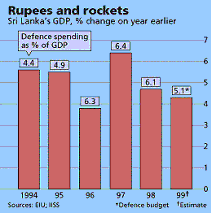
At the time of the most recent budget, in February, there was little fighting in the north and east of the island, where the Tigers claim a homeland. A sum equivalent to $730m was earmarked for defence. Fighting flared up in April, when a key government position at Elephant Pass, the gateway to the Jaffna peninsula, fell to the Tigers. This was judged to be the worst defeat suffered by the army in the war, and put down to inadequate weapons and poor leadership. Sri Lanka turned to Israel for military help. Full diplomatic ties were swiftly established, and Israeli military advisers and weapons arrived in Colombo. The Tigers now face a well-equipped army. Morale is said to be high. The command structure has improved. That is the outcome of the Israeli connection. But it must be paid for. After the Israelis came on the scene, $150m was added to the defence estimates, bringing the total to $880m. Some defence expenditure is hidden in other parts of the budget. Allowing for overspending, a realistic figure for the current year would be in the region of $1 billion. This is a little over 6% of the GDP forecast for this year, about the average for most developing countries, but higher than last year (see chart). A drifting economy is not the ideal basis for a government facing a general election. Under the constitution, the life of Sri Lanka’s current parliament comes to an end in August and an election must be called by mid-October at the latest. The president, Chandrika Kumaratunga, is not up for re-election, but she will be hoping that her People’s Alliance coalition will hold on to power in parliament. The better news from the battlefront may help her supporters. The Tigers appear to be short of recruits to replace the increasing number of their fighters killed in action. A report by a non-government group this week said the Tigers are conscripting children as young as 13. The government has long accused the Tigers of recruiting children. This week’s report may be considered less partial: it comes from the Jaffna-based University Teachers for Human Rights, most of whose members are Tamils who used to teach at Jaffna University. Still, the peace Mrs Kumaratunga has promised continues to elude her. Draft proposals for the devolution of Tamil lands were coolly received by two Tamil parties in parliament this week. Neither party supports the Tigers, but both say, no doubt correctly, that the proposals fall far short of the Tigers’ minimum demands for a guarantee of the “integrity of Tamil-speaking territory”. Mrs Kumaratunga might be tempted to try to put off the general election by extra-constitutional means, perhaps arguing that an election now would be divisive. But it would be a dangerous course for the president to take. The army is an independent centre of power in Sri Lanka. So is the island’s Supreme Court. They would be quick to defend the constitution. http://www.economist.com/background/displaystory.cfm?story_id=5677 |
|
|
|
|
|
-Copyright
© 2003 SARID, 675 Mass Avenue, Cambridge, MA 02139, USA |