|
bookmark article  email
article email
article
Sri Lanka: Civil War
Maps
MapZones:
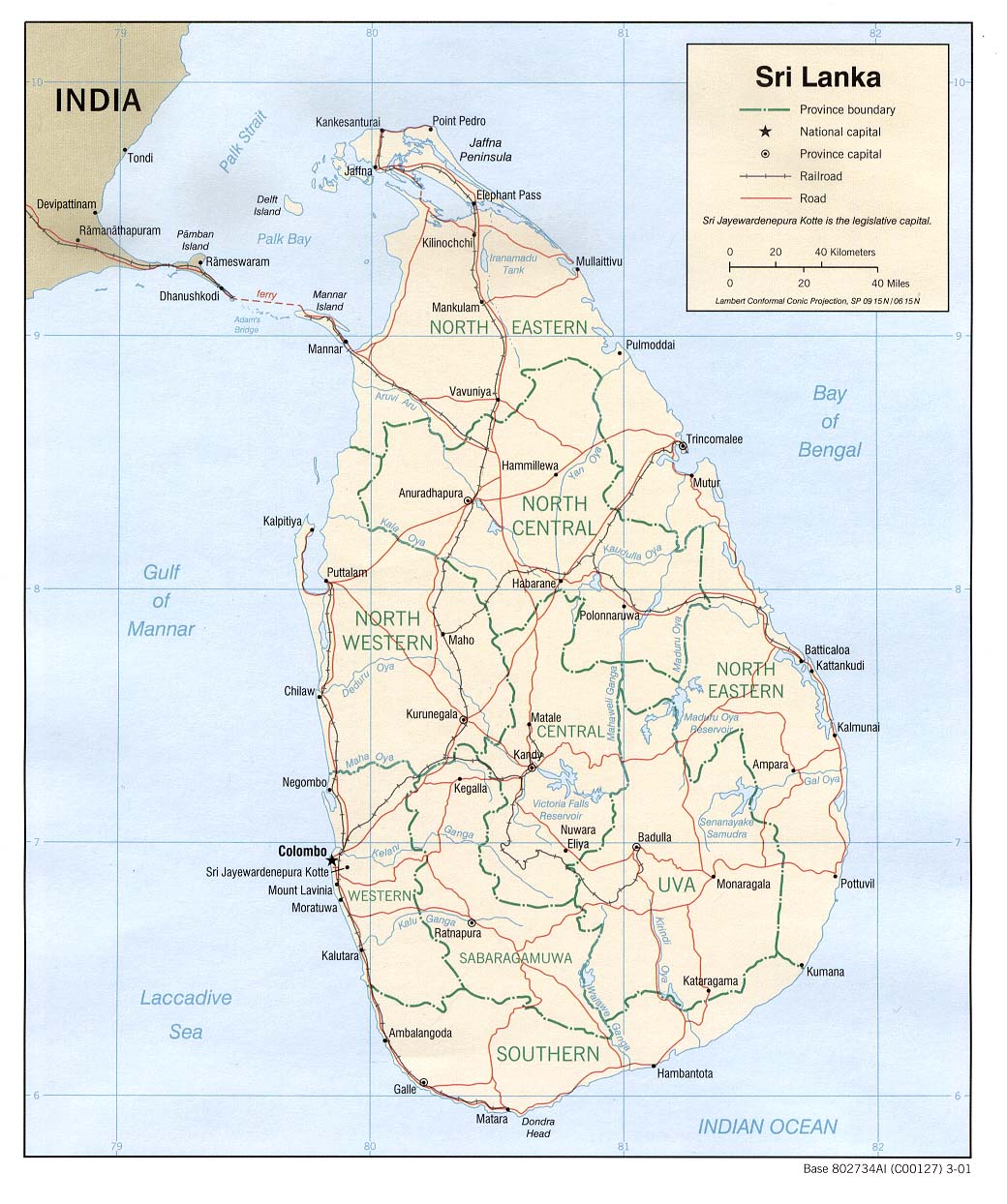
geographical map of Sri Lanka with principal towns
Lonely
Planet: Sri Lanka
University
of Texas Perry-Castaneda Map Archive: Political Map of Sri Lanka
University
of Texas Perry-Castaneda Map Archive: Ethnic/Population/Land and
Economic Maps of Sri Lanka
University
of Texas Perry-Castaneda Map Archive: Jaffna Peninsula Map
Sri Lanka
Airforce: Order of Battle Map
SARID
Original Articles
Contributions
to the Conflict Zone: Sri Lanka by SARID staff and visitors.
SARID invites interested individuals to submit relevant articles.
Please see SUBMISSIONS
to offer your contribution.
• Soma
Thero and Christmas
by V.K.
Moonesinghe, Sri Lanka
The
demise of the Venerable Gangodawila Soma, a ‘Television Cleric’,
a champion of the Sinhala-Buddhist (as opposed to the pristine Buddhist)
cause, has seen an unprecedented (in the case of a clergyman) public
display of emotion. (With links)
Current Scenario
•
As good as it gets? The Economist,
UK, October 14, 2004
FOR a year and a half, Sri Lanka's peace process has been locked
in an ugly stalemate. “No peace, no war” may be better
than the alternative.
•
Sri
Lanka gives peace another chance, Asia Times, May 5, 2004
Sri Lanka has begun a brand new chapter in the resolution of its
21-year-old civil war by inviting Norway back to broker a peace
accord with the Liberation Tamil Tigers of Eelam (LTTE), even if
under "seriously redefined parameters, [which] included a much
shorter leash".
•
LTTE
rules out Indian role in talks, Hindustan Times, May
12, 2004
Even if India was not able to recognize the LTTE as the sole representative
of the Tamil people, the LTTE condition for participation in the
Sri Lankan peace talks, it could help the Tamils reconstruct the
war-ravaged Tamil North Eastern Province, says Balasingham.
• Ceasefire
back on track, BBC, UK, April 15, 2004
Tamil Tiger rebels and the Sri Lankan army have agreed to uphold
a two-year-old ceasefire.
• A
mandate for economic issues rather than peace process, The Hindu,
Chennai, April 05, 2004
The victory of the United People's Freedom Alliance (UPFA), led
by the Sri Lankan President, Chandrika Kumaratunga, is a clear indicator
that economic issues took precedence over the peace process initiated
by the Prime Minister, Ranil Wickremesinghe's United National Party
(UNP).
• Elections
in Sri Lanka, The Hindu, Chennai, February 11, 2004
As Sri Lanka marches to its third parliamentary election in
four years, the crucial questions are whether a stable government
will emerge and how the electoral outcome will affect the Norway-assisted
peace process.
• Tiger,
Tiger, Daily News, Colombo, February 06, 2004
The Tamil Tigers are not happy with how the UNF government has gone
about the peace process.
Background
• Roots
of the regional conflict - Sri Lanka, Britannica.com, USA
Encyclopædia Britannica's Worlds Apart section examines
the role that ethnic rivalries have played in Sri Lanka and offers
insights into the issues, the people involved, and the prospects
for peace. Overview with timeline & weblinks.
• Time
Line Sri Lanka, BBC, UK
Short chronology of key events in Sri Lankan history. Regularly
updated.
• Sri
Lanka: A nation divided CNN,
USA
In-depth report with latest news, timeline & links.
• Sri
Lanka conflict - background, The Economist, UK
Brief overview, Updated regularly.
• Sri
Lanka - fighting for peace, InterPress Service, 2002
A look at peace negotiations & key events in the conflict.
• Timeline
of the Tamil conflict, BBC, September 2000
Brief chronology of key events in the conflict from 1972-2000
• Ethnic
conflict in Sri Lanka, University of Southern Maine, USA, 2000
A Case Study.
• Sri
Lanka: How ethnic tensions grew, BBC,UK, January 1998
Brief guide to ethnic groups, historical origins of tensions, grievances
& recent events
• Ethnic
Conflict in Sri Lanka & Regional Security, Lacnet, Colombo,
1987
Extensive examination of the conflict by Kumari Jayawardhana
Analysis
• Tamil
Tigers a law unto themselves, November 06, 2003
Sri Lankan guerillas abolish the death penalty from their
legal system, writes Christopher Kremmer.
• A
maximal proposal, Outlook India, New Delhi, November 04, 2003
The surprise was not that the LTTE did, in fact, make maximalist
demands. The surprise is that they did it so well. By clearly refraining
from frontally addressing emotive issues, they've prevented immediate
red flags.
• Nothing
federal about this, The Hindu, Chennai, November 04, 2003
The proposals by the LTTE for an "Interim Self-Governing
Authority for the North-East of the Island of Sri Lanka" passed
on to the Sri Lankan Government make one thing plain. Federalism,
the essence of which is the division of legislative, executive and
judicial power between the Centre and the States or Provinces, is
the last thing the Tigers have on their mind. The proposals, through
which the LTTE seeks "plenary" control of the region in
all aspects of governance, are a blueprint for a separate state.
• Small
arms threaten Sri Lanka's stability, Reuters Alertnet, USA, September
30, 2003
Humanitarian groups are concerned small arms and light weapons
could have a negative impact on the peace process and human development.
By undermining the safety and security of communities, threatening
livelihoods, and destroying social networks, they at best hold back
and at worst contribute to the reversal of hard-won development
gains,
• Sri
Lanka's Child soldiers, BBC, UK, January 31, 2003
The UN children's agency is trying to find out what Sri Lanka's
Tamil Tiger rebels are doing about their child soldiers. The issue
is casting a shadow over peace talks.
Peace Strategies
• Full
Text: Tamil Tiger proposals, BBC, UK, November 01, 2003
The proposal by the Liberation Tigers of Tamil Eelam on behalf
of the Tamil people for an agreement to establish an interim self-governing
authority for the north-east of the island of Sri Lanka.
• Peace
process: the international dimension, Daily News, Colombo, September
29, 2003
In
a landmark address to the United Nations General Assembly on
Friday, Prime Minister Ranil Wickremesinghe assured the international
community that the government "will do everything in its power
to keep the peace process moving forward to a successful conclusion".
• Japan's
role in Sri Lanka's peace process, Asia Times, March 19, 2003
In his policy speech in January, Prime Minister Junichiro
Koizumi emphasized Japan's determination to support the Sri Lankan
peace process. The emergence of Japan as a leading player in the
negotiations to end nearly 20 years of civil war and in the post-war
reconstruction plans is underscored by a decision by Tokyo last
month to provide a aid package worth US$270 million.
• Negotiator
says global support key, New York Times, USA, November 19, 2002
It's not the cash
but the signal you send by giving it. That was the message from
Sri Lanka's top peace negotiator Tuesday, ahead of an aid conference
in Oslo next week where the government and Tamil Tiger rebels hope
for support to underpin a peace bid aimed at ending 19 years of
ethnic war.
• Chandrika
proposes panel for ethnic reconciliation, The Hindu, November 13,
2002
The Sri Lankan President, Chandrika Kumaratunga, today proposed
the setting up of a National Commission for Ethnic Reconciliation
and Sustainable Peace, with the participation of the Liberation
Tigers of Tamil Eelam (LTTE) to resolve the decades-long ethnic
conflict.
• Sri
Lanka: Development is key to continued peace, says PM, IPS, September
20, 2002
Economic development in parts of the country devastated by 20 years
of bloody civil war will be key to maintaining harmony as peace
talks continue, Sri Lankan Prime Minister Ranil Wickremesinghe told
reporters Friday. The leader visited the United Nations in
New York two days after the highly successful first stage of peace
talks between the government and separatist Liberation Tigers of
Tamil Eelam (LTTE).
• Rights
Safeguards Key to Sri Lanka Peace, Human Rights Watch, July 03,
2002
Human Rights abuses by both the Sri Lankan government and the Liberation
Tigers of Tamil Eelam (LTTE) have fueled the conflict and must be
directly addressed in the peace process, Human Rights Watch said
today. Both parties should agree on human rights safeguards to help
resolve two decades of bitter conflict over political control of
the island's Tamil-dominated north and east.
• Sri
Lanka's long war,
Foreign Policy in Focus, Volume 5, Number 35, October 2000
Sri
Lanka’s troubles will only be solved through a political settlement
guaranteeing the fundamental freedom and human dignity of all Sri
Lanka’s citizens, regardless of their ethnic or religious
identity. The U.S. needs to make stronger efforts to encourage the
government in that direction, while discouraging the military option.
•
Looking
for Peace in Sri Lanka, Serendipity, issue no. 2, December 1993
Bob Tellander's Political Sociology Class at Sonoma State Univerity
examines the problem and suggests some options.
Reports & Research Papers
• Political
crisis in Sri Lanka, November 2003
Report with timeline & views from the South Asian & International
press.
• Sri
Lanka Virtual Library
• Sri
Lanka: Human Rights & The Peace process, Human Rights Watch,
July 2002
Briefing Paper
• Human
Rights Watch World Report 2002: Sri Lanka
• US
Committee for Refugees 2002, Country Report Sri Lanka
• Sri
Lanka Assesment 2002, SATP
• U.S.
Department of State, Annual Report on International Religious Freedom
for 2002: Sri Lanka
• Ecological
consequences of the war in the Tamil homeland in Sri Lanka,
PICTNSPSL, Ottawa, Canada 1999
Paper by T Saverimuttu, N Sriskandarajah, VIS Jayapalan in the Proceedings
of the International Conference On Tamil Nationhood & Search
for Peace in Sri Lanka.
Archives
• Heed
the lesson from Sri Lanka, Rediff.Com, India, November 10, 2003
President Chandrika Kumaratunga did both herself and her
country a disservice by attempting a very constitutional coup against
Prime Minister Ranil Wickramsinghe and declaring, what turned out
to be, a very gentle and short-lived Emergency.
• The
tiger's claw, Sydney Morning Herald, Australia, November 08, 2003
This week's constitutional coup in Sri Lanka has jeopardised
a promising dialogue between the Government and Tamil rebels.
• Implications
of the LTTE proposals, The Independent, Dhaka, November 06, 2003
Tiger rebel leader Velupillai Prabakaran wants to rule Sri
Lanka's North-East, two-thirds of the island nation's landmass,
and four-fifths of the seacoast for five years.
• A
glimmer of Hope for Lanka, Deccan Herald, Bangalore, November 05,
2003
The counter-proposals submitted by the LTTE to the Sri Lankan
Government since it broke off peace talks last April offer a glimmer
of hope for an eventual peaceful resolution of the ethnic conflict.
The alarmists may call it a blueprint for a de facto Eelam, an independent
State for which the rebel group has been waging an armed struggle
for over two decades now.
• Farewell
to arms? Khaleej Times, UAE, November 03, 2003
THE good news from Sri Lanka is that the Tamil Tigers have
announced they will end their eight-month boycott of peace talks
and, at the same time, invited the Colombo government to resume
negotiations after a civil conflict that has lasted almost 20 years
and claimed more than 60,000 lives.
• Tamil
Tigers step back into talks, Sydney Morning Herald, November 03,
2003
THE good news from Sri Lanka is that the Tamil Tigers have
announced they will end their eight-month boycott of peace talks
and, at the same time, invited the Colombo government to resume
negotiations after a civil conflict that has lasted almost 20 years
and claimed more than 60,000 lives.
• Sri
Lanka - rescuing the peace, The Economist, UK, July 10, 2003
Once again the Sri Lankan government has turned to Norway
to try to rescue its endangered peace deal with the Tamil Tigers.
Norway brought the two sides together 18 months ago, getting them
to agree to a truce in the civil war in which more than 65,000 people
have died in some two decades of fighting.
• US
muddies the waters, Asia Times, Hong Kong, April 17, 2003
The Sri Lankan peace process seems to have hit choppy waters.
While the threat of the Liberation Tigers of Tamil Eelam (LTTE)
to pull out of a crucial donor meet scheduled for June in Tokyo
has set alarm bells ringing, it is the international community's
declining interest in the peace process that is perhaps reason for
greater concern.
• Muslims
caught between Sinhalese & Tamils, Sunday Times, Colombo, November,
2002
• Hope
and promise, The Kathmandu Post, November 2002
• Peace
in Sri Lanka: Heartening breakthrough, The Daily Star, Dhaka, November
2002
• Colombo-LTTE
talks focus on eastern Sri Lanka, The Hindu, Chennai, November 01,
2002
The second round of direct talks between Colombo and the Liberation
Tigers of Tamil Eelam, which started here today, focussed on issues
relating to the disturbing security situation in eastern Sri Lanka.
• Prabakaran's
conviction - an ominous sign? The Hindu, Chennai, November 01, 2003
The sentencing of the leader of the Liberation Tigers of Tamil Eelam,
V. Prabakaran, to 200 years of rigorous imprisonment by a Sri Lankan
court, has come as an ominous sign at the commencement of the second
round of talks between the rebels and Colombo here.
• Sri
Lanka's 'Muslim question', BBC, UK, October 31, 2002
The violence between Sinhalese and Muslim mobs in the Sri Lankan
capital on Wednesday was the first of its kind in Colombo for decades.The
clashes point to the underlying social, political and economic tensions
dividing the Muslims from other communities in the country.
• Sri
Lanka: dimensions of a crisis, The Hindu, Chennai, October 2001
Government-Opposition polarisation has always provided space for
the LTTE to intervene, decisively and dramatically, often forcing
the Colombo-based political forces to react in panic. In early July,
the LTTE struck - a dramatic, high-visibility attack on the Katunayaka
Airport - with unprecedented economic costs, says Jayadeva Uyangoda.
• The
road to peace in Sri Lanka, BBC, UK, September 16, 2002
This is the fifth attempt at negotiations between the Sri Lankan
Government and the Tamil Tigers, but only the third face-to-face
talks, ever since the ethnic conflict erupted in the early 1980's.
• Exhausted
by war, Sri Lanka ponders peace, Christian Science Monitor, September
16, 2002
After seven years of stony silence, Sri Lanka's rival factions are
ready to talk. The Sri Lankan government will begin peace talks
Monday with the Tamil Tigers, an ethnic guerrilla force that has
waged a separatist war on the island for almost two decades.
• To
Thailand in hope, But what will life be like if the Tamils win their
homeland? The Economist, September 05, 2002
It could be “the best news to come out of South Asia in a
long time.” So says a diplomat of the peace talks between
Sri Lanka's government and the Liberation Tigers of Tamil Eelam
(LTTE) that are scheduled to begin in Thailand on September 16th.
• Sri
Lanka: Spirit of inclusion augurs well for peace talks, IPS, September
2002
The presence of Rauff Hakeem, leader of Sri Lanka's largest Muslim
political party, among the negotiators at the talks between Colombo
and separatist Tamil rebels here places this round of peace negotiations
in a league of its own.
•
Sri
Lanka's uneasy peace, BBC, UK, August 14, 2002
Charles Haviland goes to Sri Lanka and meets Sinhalese people who
are crossing into land that's been enemy territory for the last
two decades.Thousands make this journey in the shade of the current
ceasefire.
• War-weary
Sri Lankans yearn for lasting peace, San Francisco Chronicle, July
06, 2002
F or the first time in many years, a tempered optimism exists that
peace is at hand in one of Asia's longest wars. Both sides agreed
to a cease-fire in February, but such truces have dissolved in the
past. Talks brokered by Norway are scheduled to begin sometime this
summer in Thailand.
• Sri
Lanka: Costly peace, Hindu Business Line, Chennai, May 06, 2002
For the
Sri Lankan Prime Minister, Mr Ranil Wickremesighe's Government,
the peace process is running up a huge bill, not only in political
terms but also the economic cost of keeping the process going.
• Hidden
legacy of Sri Lanka's war, BBC,
UK, February 04, 2002
Tamil Tiger rebels who control large portions of northern Sri Lanka
say they estimate there are up to two million unexploded landmines
in their territory. They say so far they have had no international
assistance whatsoever in the dangerous task of clearing them.
• Quaint
feel to epicentre of Sri Lankan conflict, Yahoo India News, April
22, 2001
The town of about 50,000 in the northern Jaffna peninsula wears
all the scars and pockmarks that result from having been occupied
by three different armies during the last two decades. But
as hopes grow of peace talks between the government and Tamil Tiger
rebels, Jaffna has a rustic air with street commerce booming and
people living an apparently normal life.
• The
war the world is missing, The Economist, UK, October 05, 2000
The Tamil Tigers’ struggle in Sri Lanka is one of the
longest-running wars. But as the island prepares to go to the polls,
both sides are losing interest in suing for peace.
• Rebels
without a childhood in Sri Lanka war, New York Times, September
11, 2000
Renuka, a 13-year-old
wisp of a girl, said she is afraid she will be scolded because she
chose not to swallow her cyanide capsule. Recruited at age 11 by
ethnic Tamil rebels to fight for a separate state, she lay wounded
on the front lines of Sri Lanka's civil war six days ago, surrounded
by the blasted bodies of three other insurgents who were on duty
with her when mortar fire hit their sentry post.
• Conflict
Resolution in Sri Lanka: problems, prospects, Ilankai Tamil Sangam,
August 2000
President Kumaratunga's blow-hot-blow-cold approach to the Tamil
national movement has served to strengthen both the Buddhist clergy
and the army: two major obstacles to the peaceful resolution of
the conflicts around the multiple national movements in Sri Lanka.
• Sri
Lanka - growing cost of war, The Economist, UK, July 13, 2000
The Tigers are being held in check, but at a price. Although
the war remains affordable, at least in financial terms, there are
signs of strains in the economy as a result of a surge in the fighting
in recent months.
•
Sri
Lanka women at war; Tamil rebel group is now one-third female, IHT,
March 2000
• Stalemate
in Sri Lanka, World Confrontation Now, January 2000
• The
New Woman in Sri Lanka: Living in a conflict zone, Oxfam Community
Aid Abroad, October 1999
Forced by a brutal war the women in the conflict regions in Sri
Lanka are breaking the traditional barriers and assuming new roles.
• Sri
Lanka - civil war without end, The Economist, UK, December 03, 1998
Opinions differ over when the conflict started. Those with
long memories say August 1972, when Mr Prabhakaran threw some bombs
at a carnival in Jaffna, the main city of northern Sri Lanka, where
the Tamils live - Tamil Eelam, as they call it.
• A
continuing ethnic war tarnishes the pearl of the Indian Ocean, National
Geographic, January 1997
Sri Lanka is a world of modern comforts and complexities, a nation
of 18 million people gathered from waves of conquest , trade , and
colonization , a nation still struggling to find unity. For the
past 13 years it has been wracked with ethnic violence and social
insurrection in which some 100,000 islanders have died or simply
disappeared.
• Conflict
in Sri Lanka & international response, The Bergen Conference
1996
Lacnet Article.

|